




emgleski sadržaji 2
¦ Parish church of St. George ¦ Franciscan monastery ¦ St. Anthony's church ¦ Fort Fortica ¦ Lighthouse ¦ Statue of St. Nicholas ¦ Large graphite ¦ Statues in the park ¦ Monument to the victims ¦ Cross with altar ¦ Chapels ¦ Cemeteries ¦ Procession on Good Friday ¦ Christmas Eve ¦

 - built in 1897 in neoromanic style. In terms of layout, the church has a cross shape. The main entrance is facing south and the belfry has three bells. The main altar is dedicated to St. George, from whom the town gets its name. The west altar is dedicated to Our Lady of Health, whose statue in carried in the procession on her holiday thru the town. The east altar, transferred from the old church is dedicated to Our Lady of the Belt.
  On the main altar, among other things, is the statue of St. George killing the dragon. The same motive is also present on the large round painting on the selling and on the church flag, located on the right of the altar, with an inscription: “St. George guard Sućuraj”. In the front yard of the church one can still see the foundations of the old church which was also dedicated to St. George. It is unknown when the old church was built, but there is mention of it in the Baylaw of the city of Hvar in 1331. It was demolished due to frazzle in the late 19th century during the built of the new church. Just left of the entrance to the church yard there is a memorial plaque written in Croatian version of the Cyrillic script called bosančica, dedicated to the bishop, father Bartul Kačić Žarković, set by the duke Petar Kulušić.
 - was probably built in the 9th century. The monastery was Augustinian at first and today is Franciscan, and it is the oldest preserved building in Sućuraj. Over the entrance gate of the monastery there is a sign that reads: “The monastery of the brothers of the order of St. Augustine rebuilt in 1309” (translation from Latin). The monastery was destroyed and rebuilt many times with the last renovation in 1994. It is presently being occupied by Franciscans from the province of Bosnia who perform the parish duties for Sućuraj, Bogomolje and Gdinj. There is a rectory in the monastery with an archive of important documents and in the monastery treasury a large roman mosaic found on its grounds.

 - was built in 1663. In the 16th and 17th century many refugees from the mainland, fleeing the Ottomans, settled in Sućuraj and with the Franciscans built this church. In addition to the church they built the monastery, now a family house. St. Anthony's church guards the oldest painting in Sućuraj which represents St. Paškal, Our lady of Karmel and St Roko and is probably the work of artisan Philip Nadij from the 18th century. The church also contains an archeological collection of amphorae and an anchor from a sunken roman galley. Interestingly, there are two statues of St. Anthony: St. Anthony of Padova (to whom the church id dedicated) and St. Anthony the Monk. In folk stories these two are known as “St. Anthony the thin” and “St. Anthony the fat”. Alongside these, there is also statue of St Nicholas, a saint worshiped in Sućuraj, along with St. Anthony and St George. The statue of St. Anthony of Padova is carried every year thru the town on St. Anthony holiday, as well as St. Nicholas statue on his holiday.
 - was built in 1623, after the Ottomans plundered and burned down the village three times. During the Venetian-Ottoman wars Sućuraj was on the border of three countries: Venetian Republic (whom Sućuraj was a part of), Ottoman Empire (which held the coastline surrounding Makarska) and the Republic of Dubrovnik (which held the Pelješac peninsula). The fort was built in order to protect the port and the village and it was equipped with cannons and standing military crew what secured a much safer life for the inhabitants of Sućuraj. The fort was heavily damaged in the WWII, in the Allies bombardment of Sućuraj on March 24th 1944, what resulted in complete destruction of the tower, the interior and a large porting of defense walls. The appearance of the fort prior to the bombing can be seen in this photo.
- was built in 1889 and is still in function today. It is located on the most eastern peak of the island of Hvar, less than a kilometer from the town center.  In the vicinity of this lighthouse once stood an even older one, but it was destroyed in the WWII. The light on the lighthouse was automated in the 1990's, after which the lighthouse crew became expendable . Before that the lighthouse keepers lived in the lighthouse with their families, especially those with school –age children due to the vicinity of the town school. The lighthouse is one of the signature landmarks of Sućuraj and an incentive for many amateur photographers.The building has sinds been redecorated and is now available as a holiday let for tourists. More info on page Lighthouse Sućuraj.
 - was placed in 2003, just prior to St. Nicholas’s holiday. It is located on the end of the old part of the pier built in 1870. St. Nicholas is patron saint of seamen, travelers and fishermen, which is important in Sućuraj as it is traditionally a town of seamen and fishermen . The statue is bronze, 3,2 meters tall and is a work of academic sculptor Dijana Iva Sesarić from Solin. The cast of the statue was made in Vele Luka on the island of Korčula by Vladimir Šeparović. The solemn blessing of the statue was on December 6th 2003 and photo reportage of the ceremony can be seen here.
 - in the summer of 2013, Stjepan Voženilek Chipy, a great enthusiast of graffiti and Sućuraj, drew a graffiti on a concrete wall of the new part of the breakwater. The graffiti is 45 meters long, 2,2 meters high and is, according to the author, longest independent graffiti in Dalmatia. The technique used to draw it is spray (Montana Black and Montana Gold). The central part of the graffiti makes the inscription SUĆURAJ, on the left side there is the municipality crest (St. George on a horse killing a dragon) and on the right side there is a crest of Mladost, the football team from Sućuraj which plays in Hvar football league.
 - were placed in 1999. The small park in the centre of the town holds 3 stone statues: a woman with a fish (called Šofija), stone water drops and a monument to the old school. The old school and township building was located on the site of the park, built in 1888 and was the most beautiful building in town. By the end of WWII the building housed a German garrison. The Germans blew the building up on September 21st 1944 as they were leaving so that nothing of it remained and the appearance of the building can be seen here. The three statues were made in the summer of 1997 when Ivona Biočić held a summer school of sculpture.
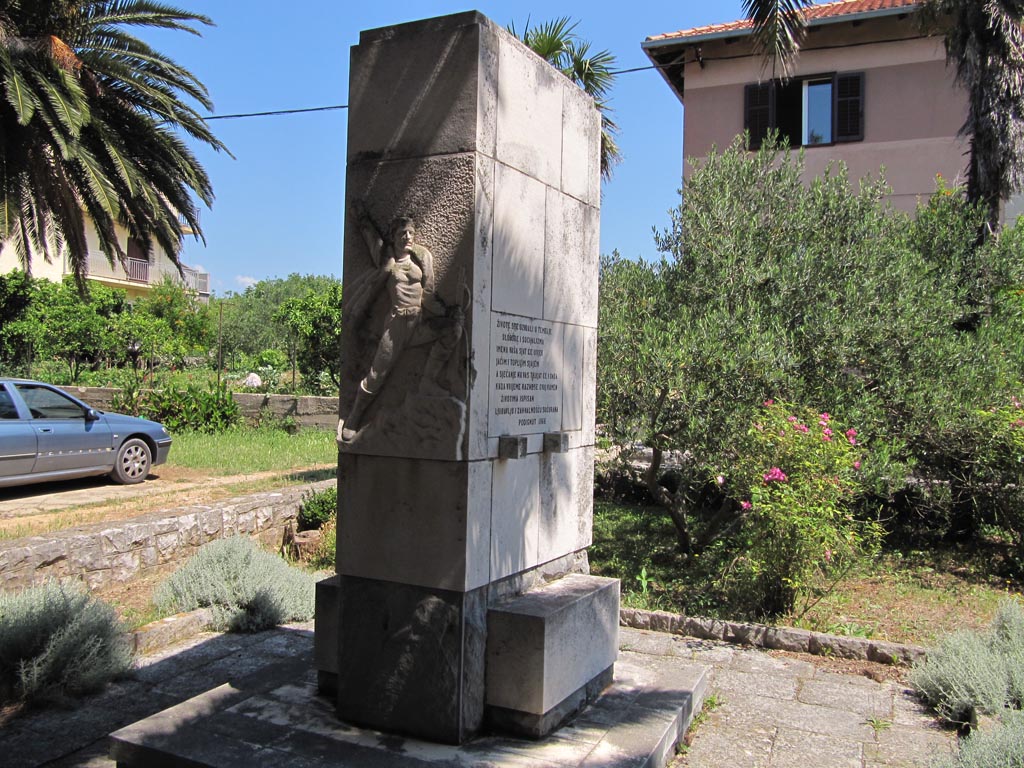 - was placed in 1996. It is located in a small park near elementary school and the infirmary. In WWII Sućuraj was heavily damaged. 40 people were killed locally and another 18 died in exile. In memory of them this monument was placed.
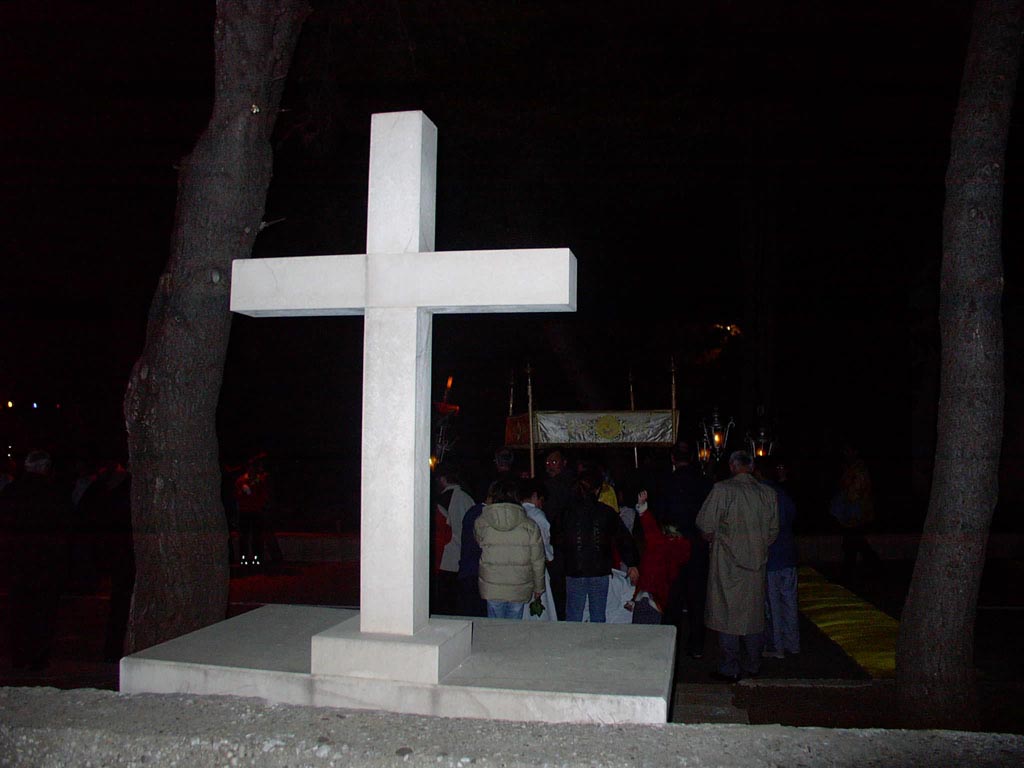 The stone cross with altar in the port was made in 1991 and was blessed in June 13th the same year. On the same place once stood a similar cross made 1872 in memory of Jesuit mission but was torn down after WWII on communist authority.
 There are a few small chapels surrounding Sućuraj:
 In Sućuraj there are two cemeteries - the new and the old one. The main cemetery (new) in Sućuraj, built in 1923, is located on the road to the east peak, between the town and the lighthouse. Although first built in 1923 it was enlarged in the 1960's and 1970's. The old cemetery was in use from 1816 to 1923, with an occasional burial in later years. The east part of the old cemetery holds a few graves in the shape of small houses, which is a remnant of old roman customs.
  The west part of the cemetery holds a few tombstones called “bogumilski stećci” which are similar to those in Makarska's coast, Dalmatian inland, Herzegovina and Bosnia, from where a large portion of locals originated. Prior to the construction of this old cemetery, people were buried in front of the old St. George's and St. Anthony's churches as well as within them.
 On the eve of Good Friday, two days before Easter, there is a traditional and unique procession, in the memory of the torment and death of Jesus Christ. The procession begins from the parish church of St. George. The main cross bearer is dressed in black robes, holds a large black cross on his shoulders and a black hood on his head, so only his eyes can be seen. The cross bearer, whose name is kept a secret, leads the procession. He is followed by the rest of the cross bearers, who carry all the crucifixes from the church. They are followed by a priest with a monstrance. Above the priest there is canopy carried by four bearers, and on both sides there are three lamps. The rest of the procession consists of the people singing and praying all the way. The procession passes thru Gornja Banda, stops on the small square in front of the post office, continues across the port and stops for the second time in front of St. Anthony's church and continues again through Donja Banda to the cross in the port
  (where it stops for the third time) and the fourth stop is in front of St. George's church. After that the procession enters the church where people continue with song and prayer. During every one of the stops, the priest gives blessing and people rattle with traditional rattles called “škrgotaljke”. This device, known outside of Sućuraj as “čegrtaljka”, is a wooden devise used to make a big noise, and it is used in the end of Holy Week, when church bells do not ring.

 On the night of Christmas Eve a great fire (called “Badnjak” in Croatian) is lit on the west side of St. George's church. The wood for the fire is gathered in the woods or an old wooden ship is brought. The custom dictates that the fire is grand, so a large amount of wood is needed. The fire is lit at 6 PM,
  after which Christmas carols are sung. The custom dates from pre-Christian time when fire was lit because the nights were getting longer and the day needed help in defeating the night. Prior to WWII the custom was to light the Christmas Eve fire in the port.
Gastronomically there is an excellent choice of restaurants, inns and taverns in Sućuraj on the island of Hvar which include traditionally local specialties such as fish, crabs, shellfish, wine and olive oil, as well as a range of meats and vegetarian dishes. There is also a pizzeria and an ice-cream parlour at your disposal. More information and photos soon...




Česminica ¦ Bilina ¦ Mlaska ¦ Perna ¦ Towards the Cape ¦ Mačak cape and "under the road" ¦ Valica and Blace ¦ Prapatna and Židigova ¦ Mrtnovik ¦ Brigove ¦ Didina ¦ North side (the rest) ¦ South side (the rest)

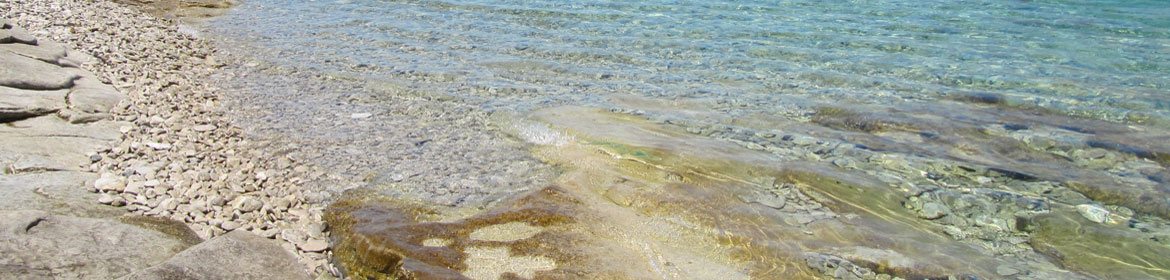
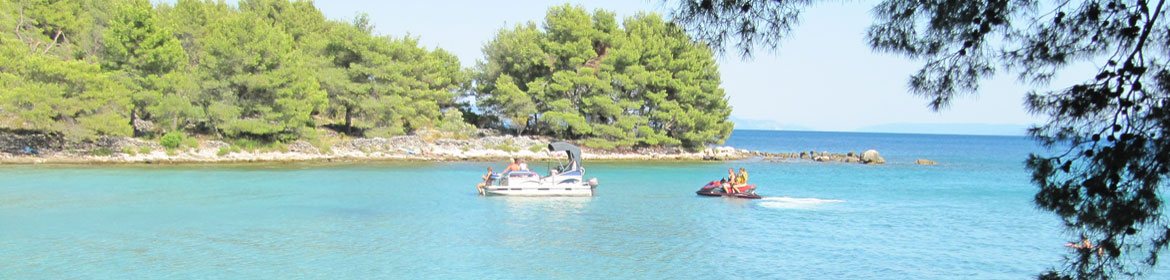
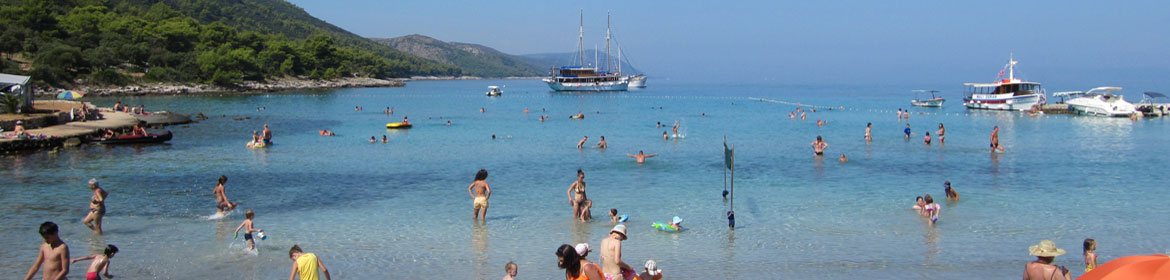
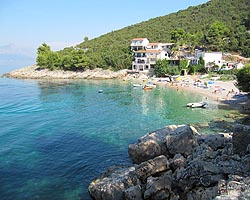
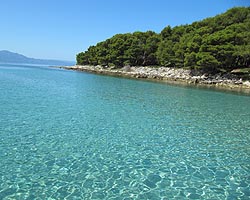
 Thanks to a climate with a large number of sunny hours, beautiful nature and crystal clear sea, with temperatures for swimming from May to October, Sućuraj is an attractive tourist destination. Those who wish to spent a day swimming and sunbathing will find it very pleasant here, because there are more than 25 km of shore with picturesque sand, pebble or stone beaches and bays. Some of them have public beaches, but in most of them you can enjoy the wilderness of untouched nature. You can spend your day on the beach near the town centre or find a hidden corner just for yourself. With the exception of the harbor, swimming is possible everywhere in the area in or near Sucuraj. Sućuraj's coastline expands on both the north and the south side of the island of Hvar, which is a great advantage. If the south wind blows, there is calm sea on the north side and vice versa, so the pleasure is guaranteed no matter the conditions.
Welcome to pebble, stone or sandy beach in Sućuraj on the island of Hvar in Croatia!
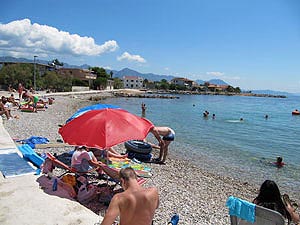 south side
 north side
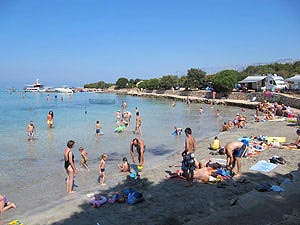 north side
 south side
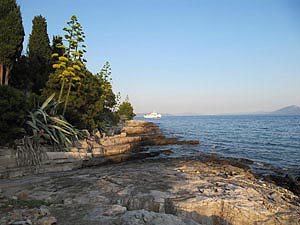 south side
 south side
 south side
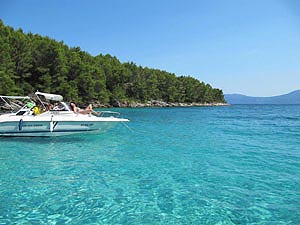 south side
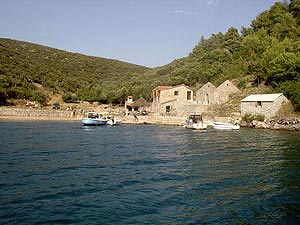 south side
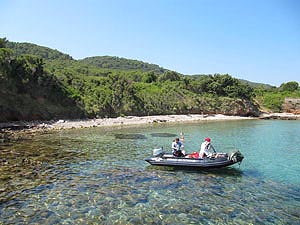 north side
 north side
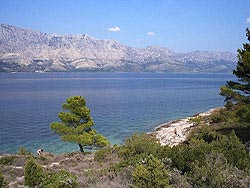 Besides before mentioned beaches and bays on the north side, swimming is possible along the whole north side of Sucuraj's coastline. From the lighthouse to Bilina there are both stone and pebble parts of the shore. A part of the rocky shore is flat and suitable for sunbathing. There is an asphalt road from the lighthouse via Bilina to Lučica and further an untarsealed road. This road passes a few bays and ends at Mlaska, with most of the road running along the shoreline. After Mlaska there is no more road whatsoever so access to bay is possible only by boat. Most of this coastline is unspoiled.
Photo gallery
 Other places on the south side that haven't been mentioned, but are also suitable for swimming are bays: Mala Perna, Žukova, Rasovaca, Oka vina, Juta grma, Slivanjske lučice, Carevića Vala and Bočić. There are no buildings in these bays, except an occasional old stone cottage so you can enjoy unspoiled nature.At the bottom of these bays there are most often pebbles. After Blace bay there is no road leading by the coastline. It is possible to reach Rasovica and Carevića bays by gravel road (map here), but you can reach the rest of the south side shore only by boat.
Photo gallery
Beaches and bays - island Hvar, Sućuraj: Česminica beach, Bilina beach, Mlaska beach, Perna beach, Towards the Cape, Mačak cape, Valica and Blace, Prapatna bay, Židigova bay, Mrtnovik bay, Brigove Bay, Didina bay, North side (the rest), South side (the rest)
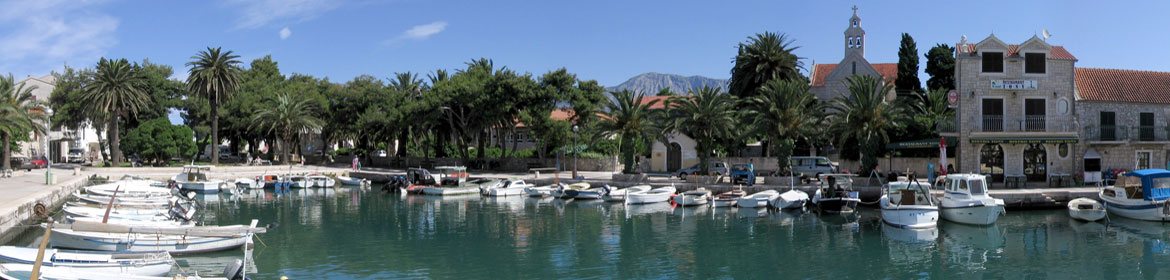
Sućuraj, a small picturesque tourist and fishermen's town and port, is the most eastern settlement on the island of Hvar (central Dalmatia, Croatia), and is also nearest to the mainland. The history of Sućuraj is very turbulent, of which there are many documents and monuments. Thanks to its position, the village has a coastline on both sides of the island. Everyone who finds themselves in Sućuraj and wants to spend the day swimming and sunbathing can choose one of the many sand, pebble or rocky beaches near the town. The sea is crystal clear and the temperature is pleasant for bathing from May all through October. Visitors can find accommodation in private apartments, holiday and boarding houses, rooms or a (motor)-campsite. There are several shops in the town and also restaurants and bars. There is also an elementary school, infirmary with the heliport for emergencies, a post office, hairdressing salon, currency exchange office, ATM, port authority office...


There are 357 inhabitants in the town (2011.) living mostly from tourism, fishing and agriculture. The town evolved around a deep and narrow bay in which the port lies. The main parts of Sućuraj are named Gornja Banda (Upper Side) and Donja Banda (Lower Side). Gornja Banda is located on a slight slope north of the port and Donja Banda is located on the south side of the peninsula. The architecture is typical Dalmatian with stone houses and narrow streets. The place gets its charm from the combination of blue seas of the Hvar and Neretva channel as well as the view of the Biokovo Mountain, Pelješac peninsula and the islands of Brač and Korčula. Archaeological finds testify of life in this area from the antiquities. The people of Sućuraj are known to be skilled fishermen, olive and wine growers and the tradition remains to this day. Gastronomically there is an excellent choice of restaurants, inns and taverns in Sućuraj which include traditionally local specialties such as fish, crabs, shellfish, wine and olive oil. For those who wish to enjoy a relaxing pace and escape the noise, crowds and hustle and bustle of everyday life, Sućuraj is an ideal location. The pleasure is guaranteed, whether you enjoy a stroll through Sućuraj's narrow streets, a seaside walk, having your morning coffee or a refreshing drink. More...


Thanks to a climate with long sunny days, beautiful scenery, crystal clear sea and temperatures suitable for swimming from May to October, makes Sućuraj an attractive tourist destination. All of those who want to spend the day swimming and or sunbathing will find the place most enjoyable thanks to its more than 25 km of coastline with sandy, pebble or rocky beaches and bays. Sućuraj's coastline expands on both the north and the south side of the island of Hvar, which is a great advantage. If the south wind blows, there is calm sea on the north side and vice versa, so the pleasure is guaranteed no matter the conditions. More...


The Island of Hvar is one of a group of central Dalmatian islands and is the longest Croatian island, populated from early historic times. Other important settlements on the island are: Hvar, Stari Grad, Jelsa and Vrbovska. Economy are based on tourism, fishing and agriculture. The island is well known for its mild Mediterranean climate and record number of sunny hours. The summers are dry, warm and long, and the winters are mild and short so the temperatures below 0°C are very rare. In 384 BC Greek colonizers from the island of Paros founded the town of Faros on the site of modern-day Stari Grad. The whole island of Hvar got its name, somewhat altered, after this colony. This island is attractive for tourists mostly because of its unspoiled nature, many picturesque beaches and bays, crystal clean sea, pleasant climate with lots of sun, historical and cultural landmarks, good healthy food, olive oil and wine, entertainment, quality accommodation, hospitable hosts and especially pleasant and relaxing atmosphere of the entire island. More...


Tourism development started in Sućuraj at the beginning of the 1960's. Hospitable people offer their guests accommodation in numerous beautiful private apartments, boarding houses (pensions), holiday houses and rooms and in motor camp in the Mlaska bay, located 4 km from the town center. On this page you can find accommodation - direct contacts with owners - no booking fee. More...
If you are not already located on the island of Hvar, the quickest way to reach Sućuraj is by ferry from Drvenik, on the Makarska Riviera. Drvenik is located 45 km from the highway exit Zagvozd on Croatia's main highway, A1. The ferry takes 30 minutes; it leaves 6 times a day in winter and 10 or 11 times a day by summer timetable. If necessary, when it is very busy, which is often the case during the height of the season, the ferry leaves more frequently. Drvenik is located on the Adriatic tourist road, 96 km southeast from Split and 120 km northwest from Dubrovnik. More...


Welcome to Sućuraj, island of Hvar, Croatia



www.sucuraj.com
• Home
• Sućuraj info
• About Sućuraj
• News
• Sights
• History
• Climate,flora and fauna
• Entertainment and culture
• Sport and recreation
• Excursions
• Fishing
• Agriculture
• Gastronomy
• Beaches and bays
• Česminica beach
• Bilina beach
• Mlaska beach
• Perna bay
• More beaches and bays
• Accommodation
• Apartments
• Houses and villas
• Rooms
• Travel info
• How to reach us?
• Ferry timetable
• Maps
• Island of Hvar info
• Gallery
• Panorama
• Beaches
• Other
• Links
• About us
• FC Mladost
• Association Pelišnjak


Sucuraj homepage - island of Hvar, Croatia


About us - Contact
Site-map
Copyright © www.sucuraj.com
Since 2001
 English
  Slovenščina


